

Why menu boards fail differently
In QSR, a technically healthy screen showing last month's promotion is still an outage — it just costs money at the counter instead of on a dashboard.
Price and promotion accuracy is the product
A menu board showing a promotion that ended last week is a pricing dispute at the counter. Content correctness matters as much as uptime.
Dayparting multiplies the failure modes
Breakfast, lunch and late-night playlists across hundreds of sites mean a scheduling mistake can be silent in head office and obvious in-store.
Nobody on site owns the screens
Restaurant crews are not AV technicians. Issues need to be detected centrally and resolved remotely wherever possible.
Multi-screen boards must agree
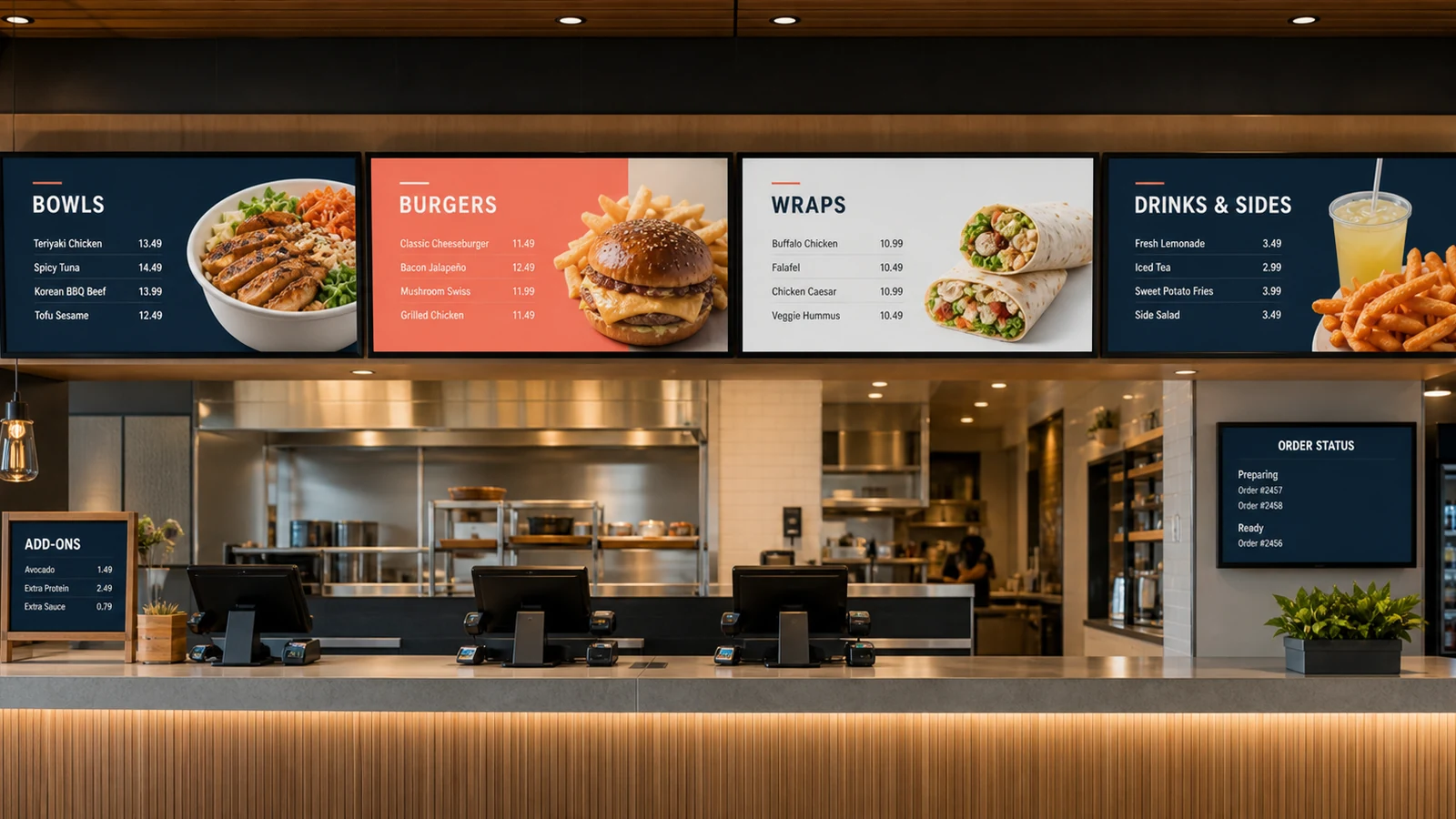
A four-panel board with one frozen or mis-scaled panel reads as broken, even when three players are technically healthy.
What the platform monitors and checks
Signal is the monitoring and device-health layer, Proof is its AI content-assurance capability, Relay handles remote actions, and Glass connects playback to commerce outcomes.
Remote device health across every site
Signal reports online status, playback state, storage and connectivity per screen and per location, so a failed panel is visible before the lunch rush.
Expired promotion detection
Proof flags offers, prices and campaign creative that should no longer be running, based on the schedules and policies you configure.
Aspect ratio and layout checks
Cropped pricing, stretched creative and layouts that render unusably on the target panel are surfaced for review rather than discovered by a customer.
Scheduling mismatch detection
Proof compares scheduled intent with playback records and rendered content where access permits, catching wrong-daypart and wrong-location playback.
Proof of play per location
Playback history by site and screen supports supplier-funded promotion reporting and internal compliance checks.
POS outcome correlation
Glass correlates what played with aggregated transaction outcomes from permissioned commerce platforms such as Square, Shopify POS, Toast and Clover, subject to available access.
Operational outcomes to expect
What typically changes in weekly operations once boards are centrally monitored and content-checked.
Fewer wrong-price incidents
Catching expired or mis-scheduled creative centrally reduces the counter disputes and goodwill discounts that follow them.
Faster recovery on a broken board
Remote restart and reconfiguration through Relay handles a meaningful share of faults without a service call.
Evidence for promotion partners
Per-site playback records make funded-promotion reporting a query rather than a spreadsheet exercise.
Scope and honest limits
- Proof assists human review. Detection coverage depends on your configuration, integration access, content type, and language support; we do not claim guaranteed detection of every error.
- POS correlation requires authorised access to the commerce platform and works on aggregated outcomes — not individual customer identification.
- Rendered-content checks depend on the screenshot or playback access each player and CMS exposes.
- Commerce and player names on this site are integration targets reachable through supported APIs, exports or scoped custom work, not formal partnerships.
Digital menuboard monitoring FAQ
- What does digital menuboard monitoring cover?
- Two layers: whether each board and player is online and playing, and whether the content on it is correct — the right menu, the right daypart, the right prices, rendered properly on the panel.
- How are expired promotions detected?
- Proof compares running and scheduled content against the validity rules and policies your team configures, then flags likely expired offers and stale creative for operator review.
- Can you catch a wrong aspect ratio or broken layout?
- Yes — Proof checks for incorrect aspect ratios, cropping, scaling artefacts and layouts that render unusably, where integration access allows the rendered output to be inspected.
- Can menu board playback be tied to sales?
- Glass correlates proof-of-play with aggregated POS outcomes from permissioned platforms. It shows relationships between what played and what sold; it does not identify individual customers.
- Does this work across multiple brands and franchisees?
- Device grouping and per-zone alerting let you separate brands, regions and franchise groups while keeping one central operational view.
Related pages
Bring your menu boards into one view
Show us your locations, players and promotion calendar, and we will walk through how monitoring and content assurance would apply.
Measuring in-store campaign impact as well? Read the retail media network measurement guide.