Signal, Relay and Glass — one platform for signage operations.
Monitor device health and content with Signal, automate sensors and remote actions with Relay, and measure audience and commerce outcomes with Glass — from a single dashboard built for digital signage operators.
Product names and logos belong to their respective owners. Integrations are built on publicly documented APIs and are optional — availability depends on provider access and licensing. Listing does not imply a formal partnership or endorsement.
Glass connects to widely used commerce and POS platforms through supported APIs, webhooks, exports, and scoped integrations — bringing location-level transactions, product performance, availability, and promotion signals into the same view as campaign and screen activity.
Core integration targets
Square
Location-level transactions, item and category performance, and promotion windows via documented APIs and webhooks.
Merchant-authorised order, payment-event, and item signals through its published developer platform.
Stripe Terminal
In-person payment events, transaction counts, and refund signals via documented APIs and webhooks.
Restaurant & hospitality
Toast
Restaurant order, menu-item, and daypart performance signals for menu-board and promotion analysis.
Available through provisioned or partner-scoped API access depending on the use case.
Lightspeed Retail
Store-level sales, SKU performance, and inventory availability through supported OAuth APIs.
Enterprise & QSR
Oracle Simphony
Enterprise QSR transaction and menu-item context, scoped to the specific API product and its permitted use.
Requires provisioned or custom access; analytics use must respect the permitted use of the specific Simphony API product rather than assuming bulk analytics access.
Warren — connect every system. Control the entire network.
Warren brings your entire signage ecosystem together — CMS platforms, players, displays, sensors, peripherals, enterprise data and AI agents — in one secure orchestration layer. Modernize, migrate and automate without rebuilding your network.
Warren orchestrates; Signal monitors, Proof evaluates content, Relay controls, Glass measures, and Scout investigates and acts.
Proof — AI content assurance
AI content assurance for every screen.
Proof continuously checks scheduled and displayed content for the mistakes that are easy to miss and expensive to show — from expired promotions and incorrect layouts to restricted language and political messaging. Configurable policies and confidence-aware alerts help operators review issues before they spread across the network.
Proof works across supported players and CMS workflows, bringing content quality into the same operational view as device health, alerts, and proof of play.
Wrong time, wrong place
Layout & aspect-ratio faults
Language & policy checks
Restricted categories
Expired & stale content
Intent vs. reality
Proof assists human review rather than replacing it. Coverage and accuracy depend on your configuration, integration access, content type, language support, and model confidence, and every check is governed by the policies you define.
Built for real-world networks
The environments screens actually run in
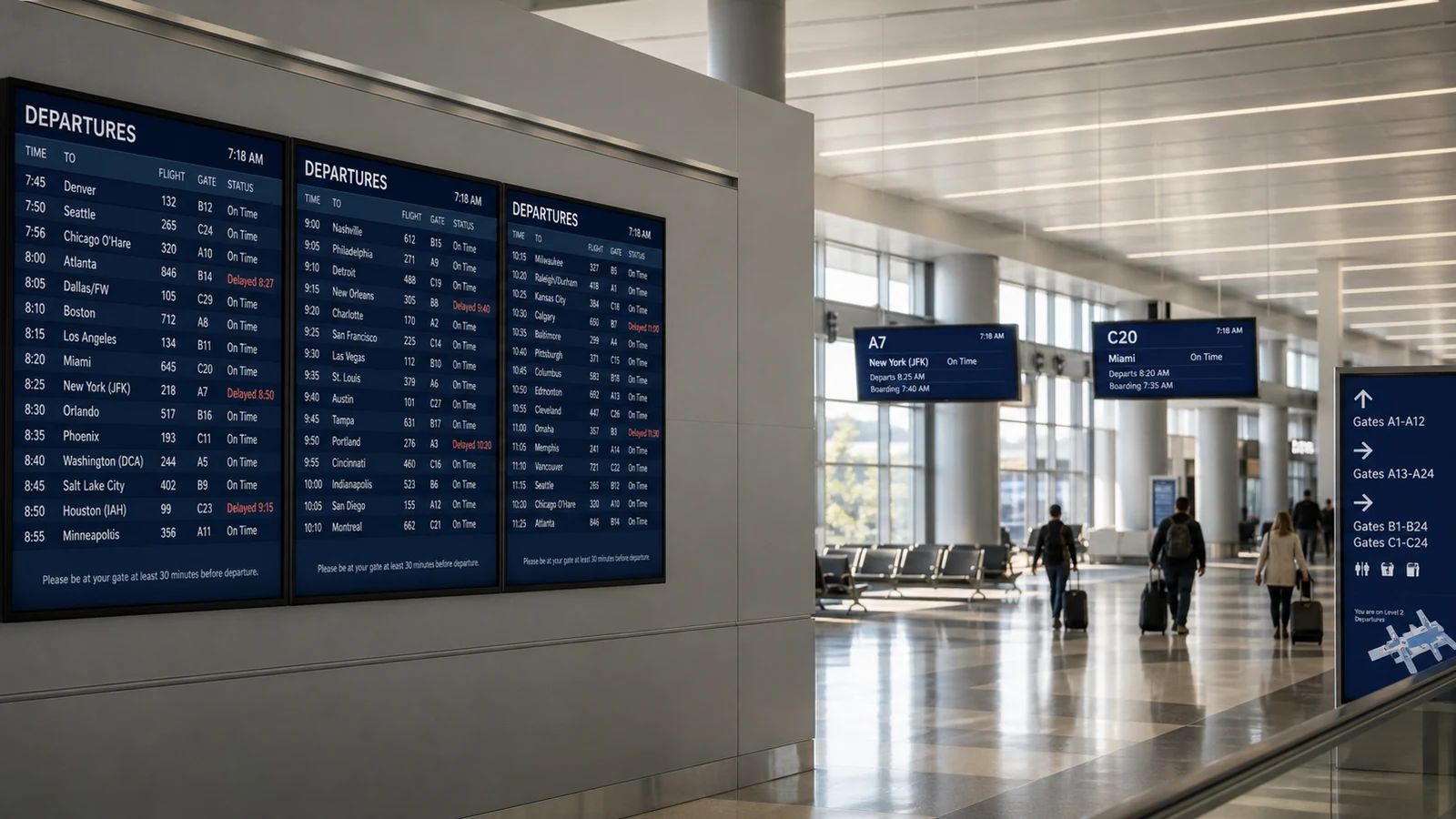
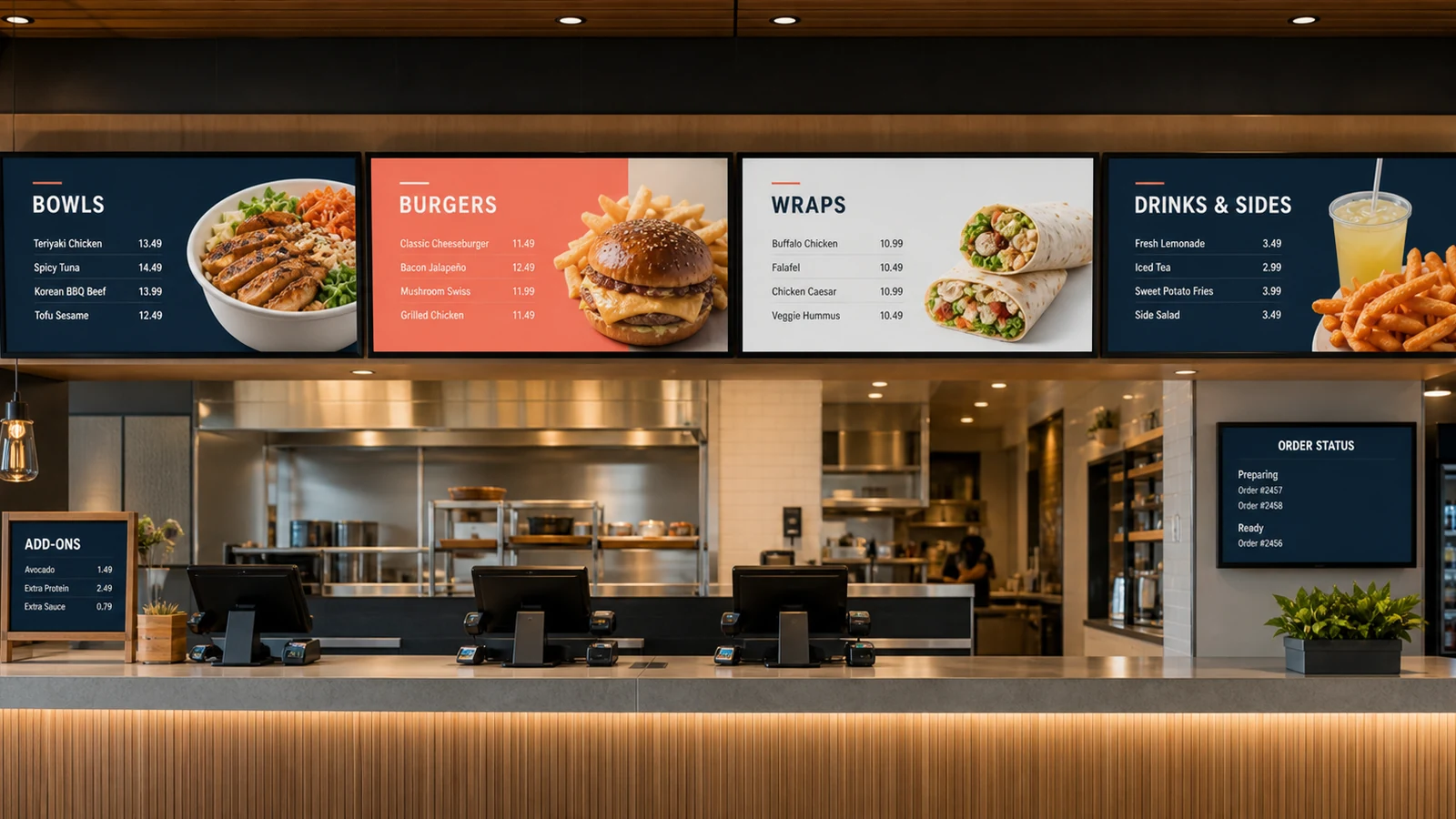
From airports and restaurants to retail stores and venues, Warren is designed around the demands of each network.
Mission-critical information networks
Manage synchronized flight-information, wayfinding, operational and passenger-facing displays across a terminal — where uptime is non-negotiable and incident response is measured in minutes, not days.
Synchronized multi-screen estates
Fast incident detection & response
Verified playback on every wall
Multi-location menu-board networks
Monitor menu boards across every location, coordinate updates, connect sensor and POS context, verify playback, and understand how each site actually performed.
Coordinated updates across sites
Sensor & POS context
Per-location performance
Retail media, large-format screens and pop-up experiences
Retail media networks, spectacular large-format sites, and short-run pop-up activations share the same need: stand something up quickly, keep it running remotely, and come away with evidence of what it delivered.
Why operators choose Rabbithole Labs
We built this platform with the people who actually run signage networks — not just the people who buy them.
Works with Navori, BrightSign, Samsung VXT / Tizen, LG webOS, Chrome OS, and Raspberry Pi.
Correlates screen playback with shelf sensors and POS data in real time.
Privacy-conscious mmWave and Nexmosphere-class sensing — no cameras, no PII.
Combines first-party signals with permissioned mobility, weather, event, OOH, and commerce data.
Built for operators who manage fleets, not just build dashboards.
A security programme aligned to SOC 2 Type II and ISO/IEC 27001:2022 control frameworks.
“We needed one place to see every screen, every sensor, and every sale. Rabbithole Labs gave us that — and cut our truck rolls in half.”
— Operations lead, retail signage network
Intelligence layer
Scout puts intelligence on top of operations
Signal, Relay, and Glass give you the signals. Scout reads them — connecting permissioned sources, detecting anomalies, and turning them into an answer and an action.
Scout
AI & MCP monitoring agents
Agents watch fleet telemetry for anomalies, correlate screen health and proof-of-play with local context and commerce outcomes, investigate likely causes, and recommend or coordinate the right response across large networks.
MCP-connected operations
Work with the systems you already run
Through Model Context Protocol, Scout agents operate against permissioned data sources — monitoring, ticketing, CMS, sensor, commerce, and analytics systems — using scoped credentials you grant and can revoke.
Audience intelligence
Reach and performance without cameras
Glass measures reach, engagement, and network performance for retail media networks and any signage estate, using aggregated signals rather than personal identification.
Connected sources depend on your provider licensing, API access, configuration, and data-governance requirements. Scope is confirmed with you during onboarding.
Security & compliance
Built for compliance-driven operations.
Signage networks sit inside retail, transport, healthcare, and financial environments. We build the platform to survive the security review that comes with them.
Least-privilege access
Role-based controls scoped to locations, devices, and actions, so people and integrations only reach what their job requires.
Auditability
Operational actions, remote commands, and configuration changes are recorded so teams can reconstruct who did what, and when.
Encryption in transit and at rest
Traffic between devices, integrations, and the platform is encrypted, and stored data is encrypted at rest.
Tenant isolation
Customer data is logically separated so one network's telemetry, analytics, and credentials never surface in another's.
Data minimisation & retention
We design around aggregated, non-identifying signals rather than personal data, with configurable retention windows per tier.
Secure integrations
Connections to CMS, sensor, ticketing, and commerce systems use scoped, permissioned credentials that you grant and can revoke.
Our certification roadmap
Our security programme is being designed and aligned around the SOC 2 Type II and ISO/IEC 27001:2022 control frameworks. We describe this as SOC 2 Type II readiness and an ISO/IEC 27001:2022-aligned security programme — we do not claim a completed audit, attestation, or certification.
Current certification and attestation status, along with architecture and security documentation, is available during procurement. Some controls described here are architectural commitments that roll out alongside the relevant product tier rather than capabilities in every deployment today.




'%3e%3cg%20id='webOS_OSE_logo_gray'%20transform='translate(1015%20769.215)'%3e%3cg%20id='Group_1'%20data-name='Group%201'%20transform='translate(0%200)'%3e%3cpath%20id='Path_1'%20data-name='Path%201'%20d='M76.937,28.38c0,8.854,6.088,13.281,14.947,13.281,9.964,0,14.949-3.873,14.949-10.515v0c0-7.627-4.985-9.227-14.949-12.059-6.879-1.811-10.855-3.607-10.855-7.952h0c0-5.077,3.806-7.431,10.8-7.431h-.006c6.57,0,10.906,2.295,10.906,9.184h2.991c0-8.852-5.539-12.174-13.842-12.174-8.859,0-13.84,3.322-13.84,9.96,0,6.463,4.981,8.966,13.837,11.49,7.35,2.031,11.963,2.936,11.963,8.983,0,5.059-4.373,7.527-11.993,7.527H91.84c-6.825,0-11.913-3.063-11.913-10.291Z'%20transform='translate(63.913%20-0.712)'%20fill='%23c30036'/%3e%3cpath%20id='Path_2'%20data-name='Path%202'%20d='M74.046.713A20.473,20.473,0,1,0,94.532,21.186,20.477,20.477,0,0,0,74.046.713m0,37.961A17.488,17.488,0,1,1,91.54,21.188,17.491,17.491,0,0,1,74.049,38.674'%20transform='translate(44.101%20-0.711)'%20fill='%23c30036'/%3e%3cpath%20id='Path_3'%20data-name='Path%203'%20d='M50.76,11.527c-4.183,0-7.244,1.585-9.192,4.5V1.012H38.581V26.466h2.988c0-7.525,3.342-11.956,9.192-11.956s9.192,4.431,9.192,11.956S56.61,38.422,50.76,38.422c-4.407,0-7.39-2.516-8.591-6.977h-3.1c1.343,6.35,5.434,9.96,11.7,9.96,7.751,0,12.179-5.532,12.179-14.94s-4.429-14.94-12.179-14.94'%20transform='translate(31.402%20-0.458)'%20fill='%23747a7e'/%3e%3cpath%20id='Path_4'%20data-name='Path%204'%20d='M35.179,33.567c-5.85,0-9.194-4.416-9.194-11.924H47.355c0-9.408-4.427-14.94-12.178-14.94S23,12.235,23,21.643s4.427,14.94,12.179,14.94c6.262,0,10.354-3.612,11.7-9.96H43.767c-1.2,4.44-4.185,6.945-8.588,6.945m0-23.851c5.024,0,8.2,3.261,8.989,8.937H26.187c.794-5.676,3.969-8.937,8.992-8.937'%20transform='translate(18.196%204.366)'%20fill='%23747a7e'/%3e%3cpath%20id='Path_5'%20data-name='Path%205'%20d='M13.139,35.777l7.607-24.13,7.61,24.13h3.361L40.79,7H37.657L30.036,31.168,22.416,7H19.074L11.456,31.168,3.835,7H.7L9.775,35.777Z'%20transform='translate(-0.703%204.619)'%20fill='%23747a7e'/%3e%3c/g%3e%3c/g%3e%3crect%20id='Rectangle_1'%20data-name='Rectangle%201'%20width='174'%20height='43'%20transform='translate(1013%20768)'%20fill='none'/%3e%3c/g%3e%3c/svg%3e)