

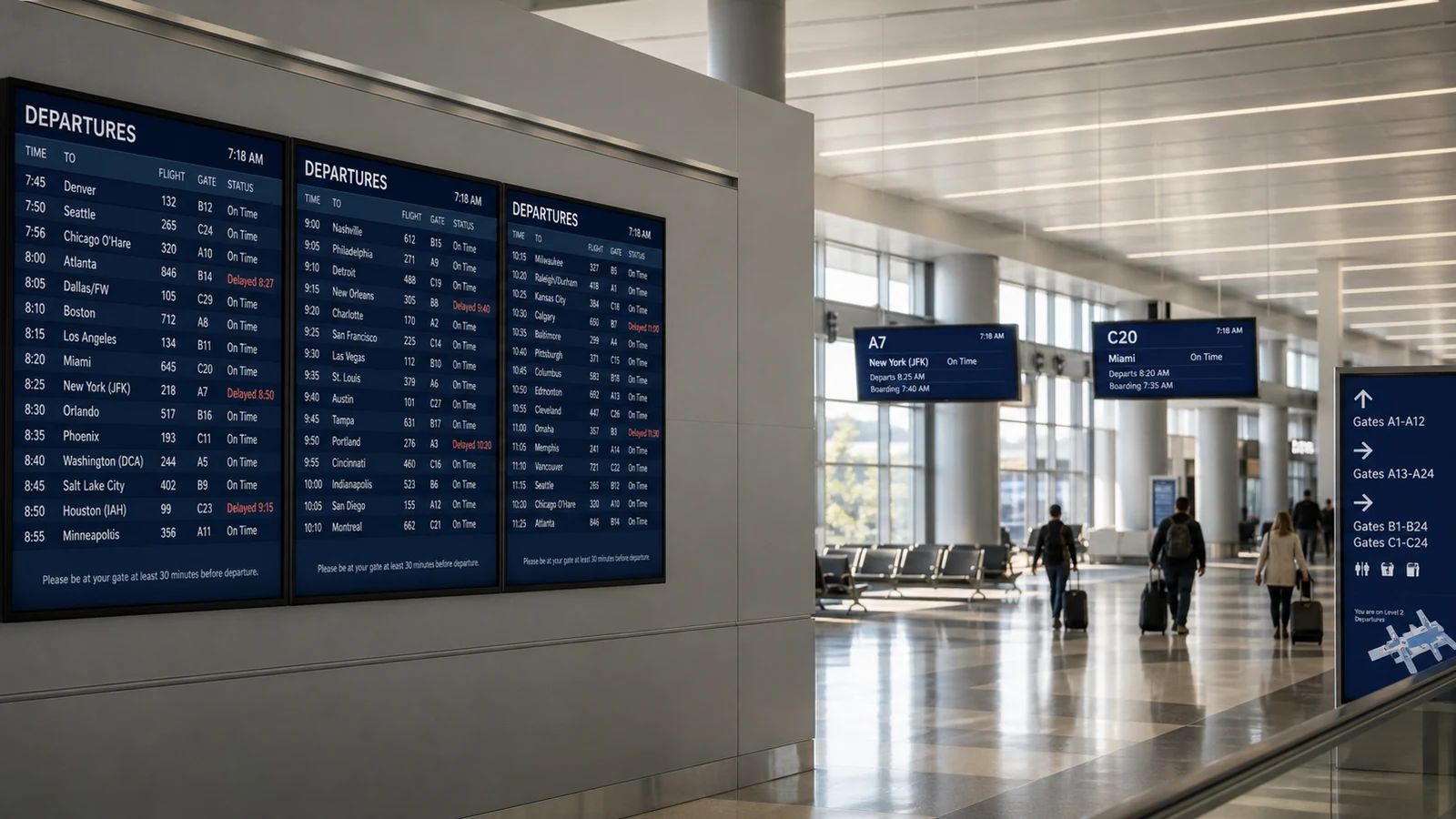
What makes terminal estates different
Airport networks fail in ways that are immediately public, physically awkward to reach, and split across several accountable teams.
Screens nobody can ignore
A dark departure board or a frozen gate screen is visible to thousands of people within minutes. Monitoring has to detect the fault before the first passenger reports it.
Distributed, mixed-generation estates
Terminals accumulate players and panels over a decade of projects. Signal presents BrightSign, Samsung VXT and Tizen, LG webOS, ChromeOS, Android, Raspberry Pi and Navori estates in one operational view.
Restricted physical access
Airside access is slow and scheduled. The more you can diagnose and correct remotely, the fewer escorted trips you need to book.
Multiple accountable parties
Airport authority, concessions, airlines and integrators often share one estate. Clear device ownership and per-zone alerting keep escalation honest.
How the platform covers the estate
Signal provides the monitoring and device-health layer, Proof adds AI content assurance inside it, and Relay handles remote and bulk operations.
Device health and uptime telemetry
Online status, playback state, storage, temperature and connectivity for every player, grouped by terminal, concourse, or zone.
Alerting and incident detection
Threshold and pattern-based alerts routed to the team that owns the screen, so an offline wall becomes a ticket rather than a passenger complaint.
Proof of play
Playback records that show what ran, when, and where — useful for concession advertising commitments and for reconstructing what happened during an incident.
Remote operations
Restart, reconfigure and run bulk workflows remotely with Relay, and use sensor and environmental inputs where they are installed.
Content assurance with Proof
Proof reviews scheduled and rendered content for layout and aspect-ratio faults, expired promotions, scheduling mismatches, and restricted categories under the policies you configure.
One view for mixed vendors
Rather than one console per manufacturer, operations staff work from a single inventory with consistent status language across platforms.
Operational outcomes to expect
Realistic, day-to-day changes in how an operations team works — not guaranteed numbers.
Shorter time to detection
Faults surface from telemetry rather than from a phone call, which is usually the difference between a quiet fix and a visible outage.
Fewer escorted site visits
Remote diagnosis and remote recovery reduce how often a technician needs airside access for something that turns out to be a reboot.
Defensible reporting
Uptime and playback history give the airport authority and advertising stakeholders a shared, auditable record.
Scope and honest limits
- Rabbithole Labs software is operational monitoring for display networks. It is not an aviation-certified system and makes no safety-of-flight claims.
- We do not claim integration with airport operational databases, FIDS content sources, or airline systems unless a supported API, export, or scoped custom integration is available and authorised by you.
- Coverage of rendered-content checks depends on the access each player and CMS exposes; Proof assists human review rather than replacing it.
- Device and platform availability varies — see the integrations catalogue for what is currently supported.
Airport display monitoring FAQ
- What is airport digital signage monitoring?
- It is continuous observation of the players and displays that run flight information, gate, wayfinding, and passenger-facing content — tracking device health and uptime, raising alerts when something fails, and recording proof of play so operators can confirm what was actually shown.
- Can you monitor flight information displays (FIDS)?
- Signal monitors the display and player layer that renders FIDS content: whether the device is online, whether it is playing, and what it rendered. Reading from an airport's flight data source itself requires a supported API or export and your authorisation.
- Do you support mixed hardware across terminals?
- Yes. Signal is built for estates that mix player generations and operating systems, including BrightSign, Samsung VXT and Tizen, LG webOS, ChromeOS, Android, Raspberry Pi and Navori-managed devices.
- How does content assurance apply in an airport?
- Proof checks for the errors that are embarrassing on a public network: wrong aspect ratios or broken layouts, content scheduled to the wrong zone or daypart, expired promotional creative, and restricted categories under the policies you define.
- Is this an aviation-certified system?
- No. It is commercial operations software for display networks. We deliberately make no certification, safety, or regulatory-compliance claims.
Related pages
See it against your terminal estate
Walk us through your concourses, players and escalation paths, and we will show how Signal, Proof and Relay would map onto them.
Running restaurant or retail concessions in the same terminal? The digital menuboard monitoring guide covers menu accuracy and promotion checks.